
The meetings with various ministries will go on till December 12, according to an office notice

What is required from government is intellectual framework.

Finance Minister Arun Jaitley presented the Union Budget.
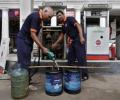
In Budget 2015, the finance minister has opted to take the slow road and has doubled the cess on coal to "balance the need to tax pollution and the price of power" in his words.

'Are all roads in India privatised? Are governments not playing a role in airports or ports? If they (private players) want to set up lines for a specific requirement, I see no reason to object. It will expand the opportunity and passengers will also benefit.'

'The clubbing of policy announcements in the Budget speech creates policy surprises.' 'Economic actors dislike policy surprises because they throw their plans off track,' points out Alok Tiwari.

Prime Minister Narendra Modi's announcement of providing free inoculation to all adults will entail total spending of anywhere between Rs 45,000 crore and Rs 50,000 crore. This is higher than Rs 35,000 crore that the government had budgeted.
Finance minister attempts a clean-up job, keeps projected expenditure growth low.

The Budget 2015-16 will include many of the schemes announced by Prime Minister Narendra Modi such as smart cities and high speed trains, Finance Secretary Arvind Mayaram said.

This is the BJP's first full-year Budget.

The Centre's capital expenditure (capex) outlay for the April-June quarter (first quarter, or Q1) of 2022-23 (FY23) could be close to Rs 1.5 trillion, Business Standard has learnt. As a percentage of full-year capex Budget Estimates (BE) of Rs 7.5 trillion, this could be at similar levels to the trends in the past few fiscal years. It is in the July-September quarter (Q2) of FY23 that capex is expected to pick up, when a bulk of the long-term capex loans to states are expected to be expended.

The government had set a budgetary target of over Rs 1.87 lakh crore for collection from customs duty in current fiscal

An aggressive rate hike by the US Fed and the possibility of a recession can trigger a slide in these stocks, which will be a good opportunity to buy from a long-term perspective.

The central government's fiscal deficit touched 67.8 per cent of the full-year target at the end of January due to higher expenses and lower revenue realisations, according to official data released on Tuesday. In actual terms, the fiscal deficit or gap between the expenditure and revenue collection during April-January period stood at Rs 11.9 lakh crore, as per the data from the Controller General of Accounts (CGA). The fiscal deficit in the comparable period of 2021-22 was 58.9 per cent of that year's Revised Estimate (RE) in the Budget.

Ahead of India's annual budget presentation next week, IMF's chief economist Gita Gopinath has favoured the extension of the pandemic support measures, thrust on investment in infrastructure and expanding health sectors programmes like Ayushman Bharat, and a very credible divestment path for commercially viable companies. The Indian government has provided a lot of schemes for small and medium enterprises, most of which is in the form of liquidity support, Gopinath told PTI on Tuesday. "And you want to revisit it and see how effectively that is working and see whether additional support may need to be provided," she said while responding to a question on her recommendations to Finance Minister Nirmala Sitharaman, ahead of her presentation of the annual Union Budget on February 1. It would be a good time for banks and Non-Banking Financial Companies (NBFCs) to raise capital given the attractiveness of financing conditions at this point, she said.

Several critics including some rating agencies have doubted prospects of meeting this ambitious fiscal deficit target.

Presenting the Budget for 2019-20 in the Lok Sabha, Finance Minister Piyush Goyal also said Rs 35,000 crore has been given under the One Rank One Pension scheme in the last three years.
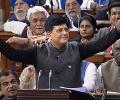
The interim Budget has attempted to tick all the boxes that could help the Modi government return to power, reports Archis Mohan.
Planning Commission on Friday said there is no case for providing stimulus to the industry to arrest moderating growth as the fiscal deficit is high and may exceed the Budget estimate of 4.6 per cent by about one percentage point.

Ahead of the new government assuming office later this month, the finance ministry has begun the Budget-making exercise to enable the incoming finance minister to present the full-fledged Budget for 2009-10.
'It is entering growth territory on a month-on-month basis.'

The government has spent a little less than one-third of the Budget estimate of capital expenditure, it can still spend about Rs 20,000 crore this year without disturbing its fiscal deficit target.

The decision to cut development expenditure does not bode well for safety and amenities.

Market hopes govt will hike capital expenditure.
Unperturbed by the rise in the fiscal deficit, Finance Minister P Chidambaram on Thursday exuded confidence that it would remain within the target of 4.8 per cent of GDP in the current financial year.

With Mamata Banerjee leaving passenger fares untouched and announcing a slew of concessions for technicians of regional film industry, cancer patients and press correspondents, railways' earnings from passenger operations may be strained further.

The railways have been able to project improvement in finances.
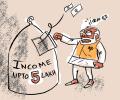
Policymakers are examining the possibility of increasing the tax-free slab to Rs 5 lakh in the two-year-old alternative personal income tax regime to make it attractive, a government official said. At present, taxpayers don't pay income tax if their taxable income is Rs 2.5 lakh and below. Increasing the threshold will reduce the tax outgo for assessees, thereby leaving more money with them to invest, the official said.

The additional outgo to combat the impact of COVID-19 will significantly erode the fiscal consolidation achieved by the state governments in the past three years, an RBI report said on Tuesday. In its study of the state budgets of 2020-21, the RBI report which has dwelled on the theme 'COVID-19 and its Spatial Dimensions in India', said that Gross Fiscal Deficit (GFD) of the states would spiral during the current fiscal.
'We carry 6.5 billion passengers every year. We have crossed seven billion this year, and are targeting 10 billion by 2030.'

The economic growth slowed to 6.9 per cent in the second quarter against 8.4 per cent in the same period last year.
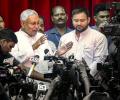
Various indicators make it amply clear that there are grave challenges facing the new government of Chief Minister Nitish Kumar, reports Indivjal Dhasmana.

'Let us hope that this Budget delivers.' 'It needs 10 per cent plus real GDP growth in 2021-22, the rebound year,' notes Omkar Goswami.

Over 60 per cent of these borrowings are slated to be mopped up in the festival season.
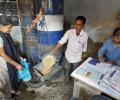
The free food scheme is driven by electoral considerations, but its long-term fiscal risks outweigh the short-term gains, cautions A K Bhattacharya.

The government has budgeted for total expenditure of Rs 34.83 lakh crore or 6.8 per cent of GDP. While the net tax revenue rose from Rs 5,75,697 crore in October 2020 to Rs 10,53,135 crore till October 2021, a growth of 82.93 per cent annualized, total expenditure rose only by 9.95 per cent, led by infra spending to Rs 18,26,725 crore from Rs 16,61,454 crore during the same period, the RBI said in the financial stability report.
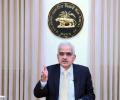
The challenge for the RBI in 2024 is likely to be less about containing elevated inflation and more about curbing excessive financial market exuberance and a 'problem of plenty', notes Sajjid Chinoy, Chief India Economist JP Morgan.
